What is Brand Purpose and How to Define It (with Examples)
Call it what you want. The Northern Star, the compass, the Obi-Wan Kenobi to your Luke Skywalker… Brand purpose is a key element of branding as a whole.
In fact, defining a purpose is one of the most crucial steps in developing a brand strategy for your business. If you don’t know what brand strategy is or what comes before finding a purpose, check this out first.
Before you start, you should have a general idea about who your ideal client is and the market landscape. Once you’ve identified those, it’s time to move on to brand purpose. In this blog, I’ll cover the following:
Table of Contents
What is brand purpose?
Brand purpose is why a business exists, beyond turning a profit.
In the Blue Zones, where people often live past 90 or even 100 years, purpose is considered a factor for their longevity. The Okinawans and the Nicoyans call it ikigai and plan de vida, respectively, which translates to ‘why I wake up in the morning’.
The same applies to branding. Just as people thrive with a purpose, brands do too. If your business has a clear and meaningful purpose, that gives you and your audience a reason to care.
Golden Circle: Start with why
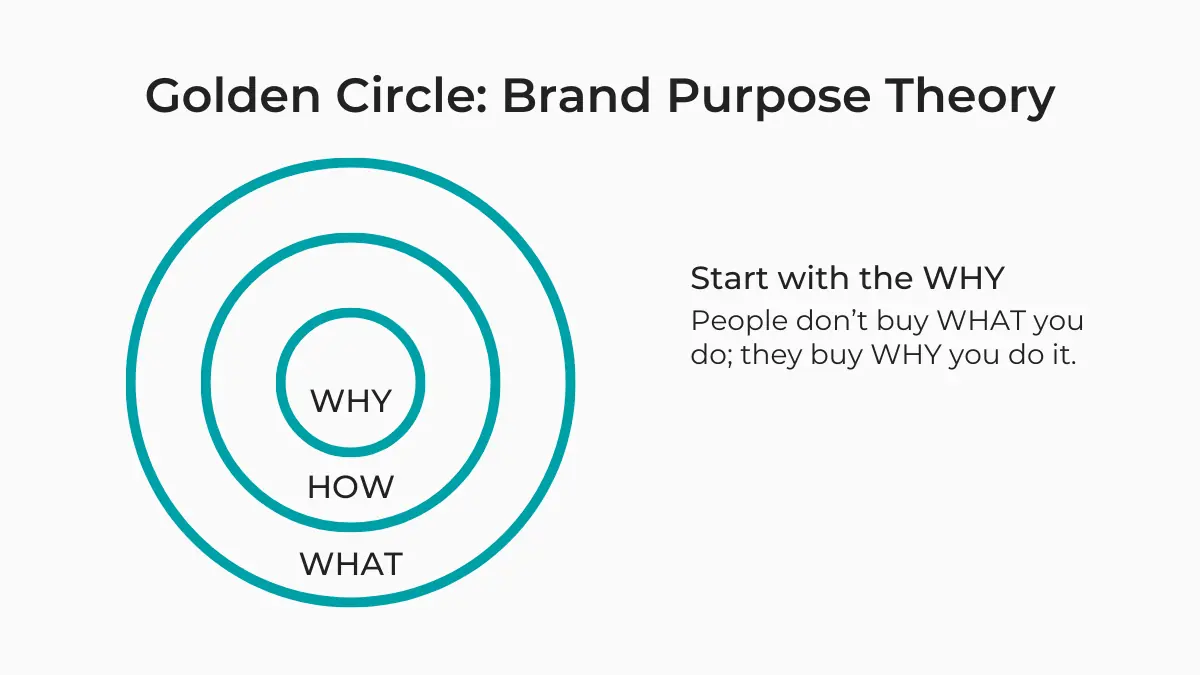
The Golden Circle theory is a three-part framework by Simon Sinek, an author and speaker best known for popularising the concept of ‘WHY’ in his TED Talk, which is one of the most-watched TED Talks of all time.
The premise is simple: Most individuals and companies start from the outside-in. They say what they do or even how, but hardly ever talk about why they do it.
What if we did business from the inside-out instead? This is what it looks like:
- WHY – Why do you exist?
- HOW – How do you do what you do?
- WHAT – What do you offer?
Sinek argues that people don’t buy WHAT you do; they buy WHY you do it.
Though this principle may not apply to all products or services, starting with WHY helps you connect with your audience on a deeper level. It gives them something to believe in, and not just something to buy.
Difference between brand purpose, vision, mission, and values
There’s a lot of confusion surrounding these concepts. Some people think purpose is the same as mission or vision. And understandably so!
You might have noticed that big brands often begin their vision and mission statements with “to + verb”. It sounds like a reason for their existence (well, almost!).
So, what sets them apart from brand purpose? Let’s take a closer look at each one.
Brand purpose, as we already discussed, provides the underlying reason a business exists, if not for monetary gains. To be more specific, it clarifies why it even came to be in the first place.
Brand vision is an aspirational statement about what you hope to achieve in the long term. Remember the typical interview question, “Where do you see yourself or what do you hope to achieve in the next 5-10 years?” Your vision statement should ideally answer that for your business.
Example: Southwest Airlines’ vision is “To become the world’s most loved, most flown, and most profitable airline.”
Brand mission conveys ‘what’ you do. A good mission statement should communicate your goal and how you intend to achieve it. That said, not all mission statements convey the how part.
Example: Asana’s mission statement is “To help humanity thrive by enabling the world’s teams to work together effortlessly.”
Brand values are the core principles that guide your brand’s behaviour and decision-making. They reflect what you stand for and what you believe in as a brand. And of course, they should support your purpose.
Example: Adidas’ values are courage, ownership, innovation, team play, integrity, and respect.
Your vision and mission are forward-looking. Your purpose, on the other hand, is about looking in… to uncover what motivates you to start or stay in business.
Why is brand purpose important?
In the past, brands rarely talked about purpose. But today, it’s a hot topic. Why is that?
Initially, consumers had no say in the market. That slowly changed when the seller-dominated market realised that its goal was to satisfy the customers. But they still dictated what the customers needed.
The landscape saw a huge transformation, thanks to the internet boom, social media, and now, even AI.
People learned to be selective and stopped trusting every brand they came across. Features or benefit-based marketing was overdone. That meant businesses needed to find a way to stay relevant in the lives of their customers.
And just like that, brand purpose came into focus. It became a new, better way to connect with like-minded customers.
A strong sense of brand purpose has several benefits for a business, such as:
- It guides internal decision-making and external messaging.
- It helps to differentiate your brand in a crowded market.
- It becomes easier to build trust with like-minded stakeholders.
- It builds emotional connection and goodwill with customers.
- It can increase the perceived value of your brand.
If you’re still debating the importance of brand purpose, here are a few key statistics based on a report from Fox + Hare, Purpose In A World Under Pressure, proving its relevance:
- 71% of consumers consider a brand’s purpose important, even amid current economic pressures.
- Additionally, 47% of people reported that it has a positive influence on their purchasing decisions.
- Yet only one-third of the consumers think brands are communicating their purpose effectively.
You might be missing out if you don’t have a clear purpose or aren’t communicating it well enough. To avoid that, let’s go through how to find your purpose and define it to drive meaningful conversations.
How to uncover your brand purpose
Brand purpose plays a crucial role in designing a strategic brand. Before you begin, it helps to understand your audience and competitors.

Knowing what your audience values and what your competitors are saying can give you a leg up in defining a meaningful purpose.
Moving on… Here are a few simple yet effective frameworks that can help you get to the core of your purpose.
The 5 Whys exercise
Remember when Arendelle was in deep, deep, deep, deep snow? Only Elsa could unfreeze it. Your purpose is Arendelle, and you are Elsa here. You need to dig deep to thaw your purpose. (Totally fair if you don’t get that reference!)
This method is as straightforward as it sounds. The 5 Whys is a root cause analysis technique originally developed by Sakichi Toyoda for Toyota Industries. By asking “Why?” repeatedly, you could move past the symptoms and find the underlying issue.
While it started on the factory floor, it can also be applied to gain a deep insight and come up with an emotional purpose.
Let’s take an example of a fitness app offering personalised workout plans:
- Why does our brand exist? To help people get fitter and healthier.
- Why does that matter? Because people struggle with building consistent, healthy habits.
- Why do they struggle with consistency? Because it’s hard to find a routine that works for them and fits into their lifestyles.
- Why? Most fitness programs are too rigid and not designed for real life.
- Why is that important? Because fitness shouldn’t feel like starting over, but rather growing into who we want to become.
See how we went from getting fit and healthy to building a consistent routine designed for real people?
It’s like peeling back the layers of an onion to reveal the core that holds everything together. Somewhere around the fourth or fifth answer, the purpose starts to reveal itself.
Oh, one more thing… Don’t throw away the rest of your answers just yet. The ‘why’ at each level ultimately connects back to the main purpose. That means you can use it for your brand messaging.
Product to Purpose
This approach is practical and suitable for pretty much any business. We start with what you offer to get to why it matters. (Golden Circle has left the chat.)
This technique is inspired by the evolution of marketing strategies. As the market evolved, businesses shifted focus from the product or service to features to benefits to desired outcomes.
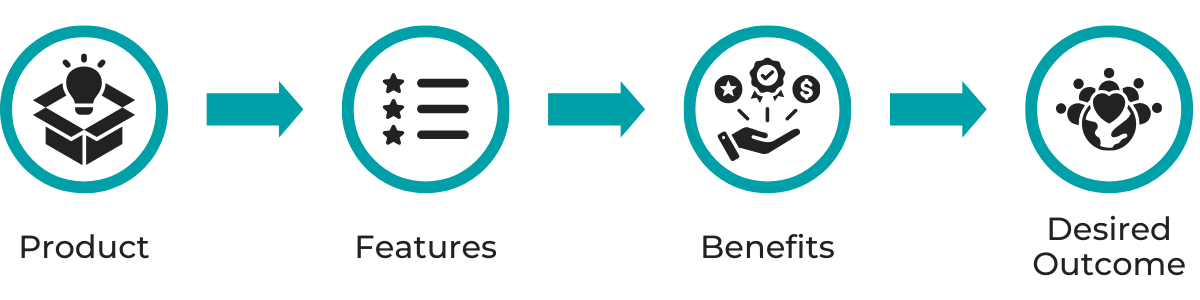
Let’s say you sell reusable water bottles:
- Product: Reusable water bottles
- Features: Made from durable stainless steel, 100% BPA-free, leak-proof design.
- Benefits: Reduces environmental impact and promotes a healthy lifestyle.
- Desired outcome/purpose: Sustainable and healthy future for you and the world.
You need to see the bigger picture to understand how it helps your consumers or society at large.
Three-Box Thinking
I came across this model when I learned about brand management. This model, developed by M+C Saatchi, combines consumer truth and brand truth to arrive at a proposition, a.k.a the brand purpose.
For this approach to work, you need to observe, observe, and observe. They believed that when you observe closely, you see human nature at its purest, most raw form. Interviews or focus groups may not always mimic that reality.
The 3 key elements are:
- Consumer truth: A universal insight that applies to your customers
- Brand truth: What you offer or do uniquely
- Proposition: A distilled purpose that combines the other 2 elements
Write down a single sentence for each of them in separate boxes. Condense your thoughts as much as possible to come up with the simplest proposition.
Here’s how M&C Saatchi applied this framework to develop a brand purpose for GlaxoSmithKline:
| Consumer truth | Brand truth | Proposition |
| Everybody is frightened of disease. | GlaxoSmithKline spends more on R&D in that field than any other company in the world. | We fight disease. |
And this is how it reflects in their statement: We are a global biopharma company with a purpose to unite science, technology and talent to get ahead of disease together.
Tips to make your purpose specific and relevant
• Choose an appropriate purpose
You might decide to champion a social cause, like minority empowerment or environmental change. Or you might define a purpose that is connected to a functional or emotional goal of your ideal clients. Choose what works for you and your audience.
• Clear > clever
When it comes to brand purpose, clear beats clever every single time. I’m not suggesting that being clever is bad by any means. But it’s better to be straightforward than risk diluting the meaning of your purpose.
• Use specific language
Phrases like “to make the world a better place” sound good and aspirational. But, in reality, it means very little. So think twice about how you put your purpose into words.
• Keep the focus on your audience
Your purpose shouldn’t be about you, at least not entirely. It may seem counterintuitive since purpose comes from within. But if it’s something only you care about, your customers may not relate to it. So find a shared reason.
The more honest and specific your purpose is, the more likely it is to resonate with your target audience and guide your brand forward.
Example of vague vs clear brand purpose statement
Now that we’ve seen how to define brand purpose and a few tips to write your brand purpose statement, here’s an example of vague vs clear purpose.
Which of the two do you think is a better purpose statement for a meditation app? And why?
(Hint: Refer to the best practices to understand which one ticks all the boxes.)
Example 1
To improve lives and make a better world through meditation.
Example 2
To help busy, overwhelmed individuals find moments of silence to rewind and reset, even on hectic days.
Defining your purpose is only the beginning. You have to give it meaning by using it effectively across your business, brand, and behaviour. That means aligning your internal culture and customer experience and translating it to visual and verbal communication.
Real-world brand purpose examples
To give you a further dose of inspiration to find your brand purpose, I’ve rounded up some of the most well-known examples of brand purpose.
• IKEA
Their business idea provides a clear motivation for existing: “To offer a wide range of well-designed, functional home furnishing products at prices so low, that as many people as possible will be able to afford them.”

It clearly states a reason for their target audience to care. They address a functional need for better home furnishing for the many, and not just the few.
• TOMS
TOMS is widely-regarded as a purpose-led brand. Their purpose revolves around improving lives. While that might seem vague or broad, they are a primary example of how purpose drives action.
They follow a ‘One for One®’ social entrepreneurship model, giving back to communities with every purchase.
• Whole Foods Market
A purpose statement doesn’t have to be limited to one sentence always. Whole Foods Market opens their purpose statement with a simple sentence, but expands on it in the next. In fact, they complete the full Golden Circle with their message.
“Our purpose is to nourish people and the planet. We’re a purpose-driven company that aims to set the standards of excellence for food retailers.”
• Lego
Their core idea is learning through play. They believe that children are natural scientists eager to experiment. LEGO shapes young minds by enabling children to think systematically and creatively.
Their purpose reflects both a functional goal (cognitive development) and an emotional one (joy of creation).
• Fenty Beauty
Fenty Beauty by Rihanna was born from a desire to truly represent and celebrate every person. She saw a void for products that worked well across all skin tones and types.
This brand is the perfect example of how a meaningful purpose can arise from market tension. Rather than “why do we exist,” the question is “why wasn’t this already here?”
• Airbnb
In an open letter, the founders talked about what makes Airbnb, Airbnb. On the surface, people came to Airbnb as a new way to travel, but below the surface, they find connection.
Their purpose has been a prime driver for their business strategies. It also helped them refocus their business during the pandemic, which had caused people to feel increasingly disconnected and lonely. With Airbnb, people could belong and feel at home.
• Disney
Disney’s public-facing purpose statement on their website, “At Disney, we are committed to creating a better world”, is rather vague and generic. You might be wondering, then, how this one made the list. Well, it’s because of their internal purpose.
Their internal purpose is descriptive and inspires action: “We create happiness by providing the finest in entertainment to people of all ages everywhere.” This mantra encourages employees to deliver exceptional customer service.
Key takeaway
In a world where nothing is constant, brand purpose aims to be a constant. More than a tagline or a PR move, it is the fundamental reason you do what you do.
A clear and consistent purpose could be the compass you need to navigate the never-ending branding journey. It defines how a brand behaves, communicates, and grows.
If you’ve defined your brand purpose and are ready to move on to the next step of branding, read this.